


California's accessory dwelling unit (ADU) law now sits in Government Code sections 66310 to 66342. SB 477 moved it there in March 2024 from the old section 65852.2, reorganizing the text without changing what it does. Three bills changed it on January 1, 2026 (SB 543, AB 1154 and SB 9 of 2025), and two more, signed on September 29, 2026, take effect on January 1, 2027. Cities and counties write their own ADU ordinances, but they cannot go below the state's floor. This is that floor as it stood in late October 2026.
What one lot can hold
On a lot with a single-family home, the city must approve, without discretionary review, any combination of:
- one ADU and one junior ADU (JADU) inside the space of the house or of an existing accessory structure such as a garage, which may grow by up to 150 square feet for an entrance;
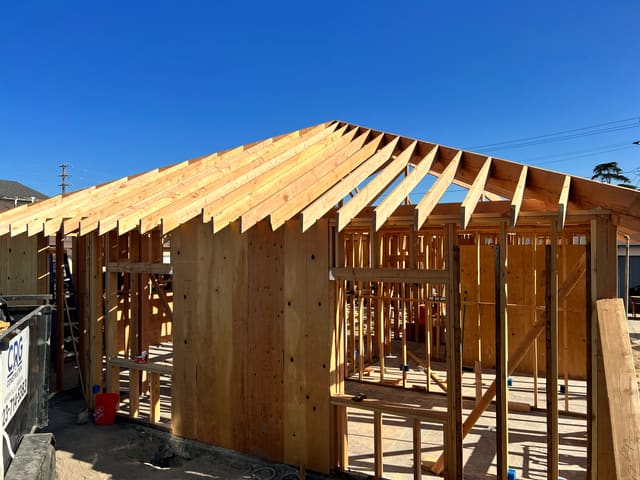
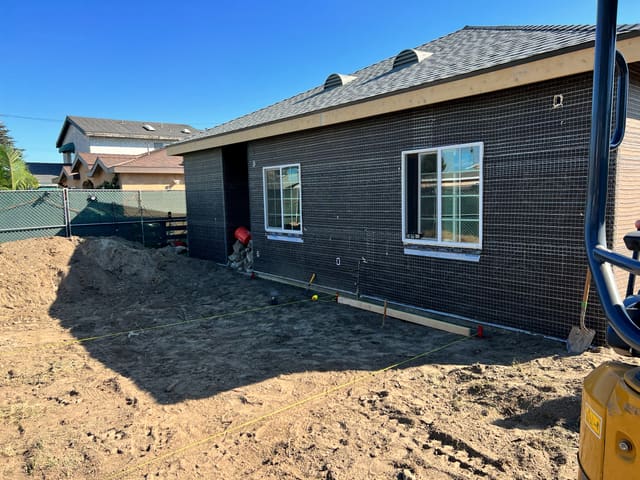
- one new detached ADU with side and rear setbacks of no more than four feet, which the city may cap at 800 square feet and at the state's height limits.
From January 1, 2027, AB 956 raises that to two new detached ADUs. On a lot with an existing apartment building, the law allows ADUs in space not used for living, such as storage rooms or garages (at least one, and up to 25% of the existing units), plus up to eight detached ADUs, never more than the number of existing units.
Size, height and setbacks
| Rule | State floor |
|---|---|
| Detached ADU | Up to 1,200 sq ft |
| Attached ADU | Up to 50% of the existing house |
| Smallest size cap a city may set | 850 sq ft, or 1,000 sq ft with more than one bedroom |
| Lot coverage, floor area or front setback rules | Must still allow an 800 sq ft ADU with 4 ft side and rear setbacks |
| Detached ADU height | At least 16 ft; 18 ft within a half-mile walk of a major transit stop, plus 2 ft for a roof pitch that matches the house |
| Attached ADU height | 25 ft or the house's height limit, whichever is lower, and no more than two stories required |
| Side and rear setbacks | No more than 4 ft; none for converted existing space or a same-size rebuild in the same spot |
Since January 1, 2026, SB 543 counts the 850, 1,000 and 800 square foot figures as interior livable space. A city also cannot set a minimum size that rules out an efficiency unit.
Junior ADUs
A JADU is a unit of up to 500 square feet built entirely inside a single-family home, and an attached garage counts as part of the home. Since January 1, 2026, under AB 1154, the owner has to live on the property only if the JADU shares a bathroom with the house; with its own bathroom, no owner-occupancy is required. The owner records a deed restriction against selling the JADU separately, and rentals have to be longer than 30 days.
Some LA County ADU guidance still says the JADU or the main house must be owner-occupied. The statute changed on January 1, 2026.
Parking, owner-occupancy and renting
A city cannot require the owner to live on a lot with an ADU. It cannot require parking for an ADU:
- within a half-mile walk of public transit;
- in an architecturally and historically significant historic district;
- when the ADU is part of the house or of an existing accessory structure;
- when on-street parking permits are required but not offered to the ADU's occupant;
- when a car-share vehicle is parked within one block.
Where parking can be required, it is capped at one space per unit or per bedroom, whichever is less, and tandem parking on a driveway counts. When a garage, carport or covered space is demolished or converted for an ADU, the lost spaces do not have to be replaced, and a JADU cannot trigger extra parking. A city also cannot deny an ADU because of nonconforming zoning, code violations or unpermitted structures on the lot that do not threaten health and safety and are not affected by the ADU.
ADUs can be rented, and a city may require rental terms of 30 days or longer. They cannot be sold apart from the house unless the city or county has adopted an ordinance allowing it under AB 1033.
Fees and the 60-day clock
No impact fees can be charged on an ADU of 750 square feet or less, or a JADU of 500 square feet or less. A larger ADU pays impact fees in proportion to the size of the main house, and from January 1, 2027, SB 1117 limits those fees, for up to two ADUs on a lot, to the area above 750 square feet. For school fees, an ADU or JADU under 500 square feet counts as adding less than 500 square feet of assessable space. An ADU or JADU created inside existing space needs no new utility connection or connection fee unless it is built with a new house; other ADUs can be charged a fee in proportion to their load on the water or sewer system.
Review is ministerial: staff check the application against set standards, with no hearing. The city has 15 business days to say whether an application is complete, or it is treated as complete. Once it is complete, the city has 60 days to approve or deny it when a home already stands on the lot, or the application is deemed approved. A denial must come with a full list of what is wrong and how to fix it. When an ADU replaces a detached garage, the demolition permit is reviewed with the ADU application and issued at the same time.
What LA County and the City of LA add
LA County's ADU ordinance covers unincorporated areas such as Altadena. An amendment was still at the draft stage in July 2026, and the County says the draft does not carry the force of law. The County offers three free pre-approved ADU plans: two of 1,200 square feet (three bedrooms and two bedrooms) and one of 800 square feet with one bedroom. They cannot be revised and must be permitted as designed, though they can be mirrored and turned to suit the lot.

Rebuilding an ADU after the fires
- Moving in before the main house. The Governor's Executive Order N-9-25 (January 16, 2025) set out to streamline building and occupying ADUs on lots destroyed by the fires, and extended the rebuild exemptions from CEQA and the Coastal Act to ADUs. Separately, AB 462 (October 2025) requires a city to issue a certificate of occupancy for a detached ADU before the main house when the main house was substantially damaged or destroyed, in counties under a state of emergency proclaimed on or after February 1, 2025.
- Altadena. Under the County's Eaton fire interim ordinance, a household can live in a new standalone ADU until January 7, 2030, while the main house is rebuilt. Where a new ADU covers a burned garage's footprint, replacement parking is waived, although in Very High Fire Hazard Severity Zones parking may still be required.
- Pacific Palisades. Under the Mayor's Executive Orders 1 and 8, a new or rebuilt detached ADU on an eligible lot is not held to the 110% footprint and height limit that applies to the main house.
- Coastal Zone. AB 462 also requires a decision on a coastal development permit for an ADU within 60 days.
CRG Construction designs and builds ADUs, including on fire-damaged lots, and handles the permit process for the units it builds. Estimates are free.
Sources
- Government Code §66314: ADU standards California Legislative Information.
- Government Code §66317: review and the 60-day clock California Legislative Information.
- Government Code §66321: size and height California Legislative Information.
- Government Code §66322: parking California Legislative Information.
- Government Code §66323: units a city must approve California Legislative Information.
- Government Code §66311.5: fees and utility connections California Legislative Information.
- Government Code §66333: junior ADUs California Legislative Information.
- SB 477 (2024) California Legislative Information.
- SB 543 (2025) California Legislative Information.
- AB 1154 (2025) California Legislative Information.
- AB 956 (2026) California Legislative Information.
- SB 1117 (2026) California Legislative Information.
- AB 462 (2025) California Legislative Information.
- Accessory Dwelling Units LA County Regional Planning.
- Accessory dwelling units (earlier County ADU page) LA County Regional Planning.
- 2026 ADU Ordinance Amendment LA County Regional Planning.
- Pre-Approved ADU Standard Plans Program LA County Public Works.
- Governor issues executive order to fast-track temporary housing (N-9-25) Governor of California, January 16, 2025.
- Eaton Fire Disaster Interim Ordinance, summary LA County Regional Planning.
- Rebuilding: Permit Support and Recovery City of Los Angeles.
Rules and programmes change. We confirm the current requirements with the permitting office for every property; nothing here is legal advice.


